Every day, we make hundreds of choices without really thinking about them. Some are minute – like whether to revise or scroll on your phone – and some feel bigger, like which GCSE subjects to take or the friends you spend your time with. In the moment, these choices seem temporary and unimportant. But psychology suggests the opposite: repeated small decisions shape long-term habits, and habits slowly shape our identity. In short, this is the process behind identity based habits, with four key parts to the way this idea is implemented.
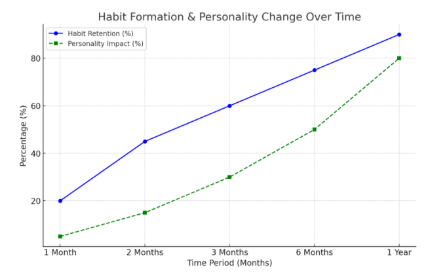
First, identity-based habits suggest that behaviour influences self-perception. Every action is like a “vote” for the type of person you believe you are. Choosing to study reinforces the identity of a disciplined, hardworking student. Conversely,repeated procrastination reinforces the opposite. Over time, people begin to act in ways that match the identity they’ve been “voting” for.
Second, the brain tries to conserve energy by turning repeated decisions into automatic habits. Processes like chunking allow behaviours to become more “automatic” the more they are repeated. Research such as the Creature of Habit Scale (2017) shows that automaticity increases over time, reducing the mental effort required for a behaviour. This frees up energy for more complex tasks and reduces decision fatigue.
Third, your small decisions will accumulate. One choice might feel insignificant, but repeated choices create long-term patterns. Environmental cues also play a role; removing distractions or changing your surroundings can shift your behaviour without you even noticing.
Fourth, small choices feel temporary because we naturally prioritise immediate rewards over long-term benefits. This preference for instant gratification strengthens habits, especially when the behaviour happens in a consistent environment.
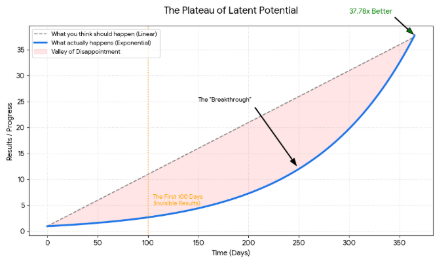
This is where the “early flatline” becomes dangerous. In the first 100 days(the Plateau of Latent Potential)you’re putting in the work, but the results are invisible. It feels like nothing is happening.
But the “1% better” is happening under the surface, like a seed germinating underground. Most people quit here, not because they’re failing, but because they can’t yet see the payoff. The dramatic “37x improvement” at the end of the year isn’t magic; it’s the delayed reward for all those boring days where you simply showed up for your habits.
To keep going, you must train your expectation engine. Your brain is an anticipation machine. Every time you make a small, positive choice, you’re not just improving a skill-you’re rebuilding self-trust.
Micro-wins send a message to your subconscious: “I am the kind of person who follows through”. Over time, this creates an identity shift. You stop TRYING to be disciplined and start BEING disciplined. The moment results appear is simply when your internal identity finally aligns with your external actions.
But the Compound Effect works both ways. If you constantly feed your mind low effort distractions or listen to critics, you’re still casting votes-just for a smaller version of yourself. Protecting your mental inputs, in other words being selective about what you consume and who you listen to,is essentially choosing which version of your future you want to live out.
Psychologically, humans are wired for comfort, not happiness. The brain treats uncertainty as a threat, activating the amygdala and pushing us toward risk avoidant behaviour. That’s why we choose immediate gratification over long term goals: the emotional brain wants relief now, even if the logical brain knows better.
This avoidance,known as Experiential Avoidance,creates the illusion of safety but often leads to stagnation.The brain prioritises quick dopamine hits, like checking your phone instead of starting a difficult task. This is called present bias. Simply put, we overvalue instant rewards and undervalue larger ones that take time to arrive. According to Bem’s Self Perception Theory, we learn who we are by watching what we do. If you repeatedly tell yourself you’re “disorganised,” you’ll interpret every small slip as proof.But the opposite is also true: small, repeated actions can rewrite your identity. Even ten minutes of effort nudges you toward seeing yourself as a disciplined person.Identity consistent behaviour strengthens positive attitudes toward that behaviour, making it more likely to become habitual. Patterns create reality.
Overall, the evidence suggests that meaningful change is gradual rather than sudden. Studies indicate that habits form through repetition, with research by Phillippa Lally et al. (2009) estimating an average of 66 days for behaviours to become automatic. This supports the idea that consistent, small actions are more influential than occasional bursts of motivation. The concept of compound improvement, highlighted by James Clear (2018), further shows that marginal daily progress can lead to substantial long-term growth. Additional research by Wendy Wood (2019) also emphasises that repeated behaviours gradually become automatic. Together, these findings emphasise that identity develops through sustained behavioural patterns over time, with long-term outcomes shaped by the accumulation of ordinary decisions.

 between the thoughts
Leave a reply to tliam229 Cancel reply